
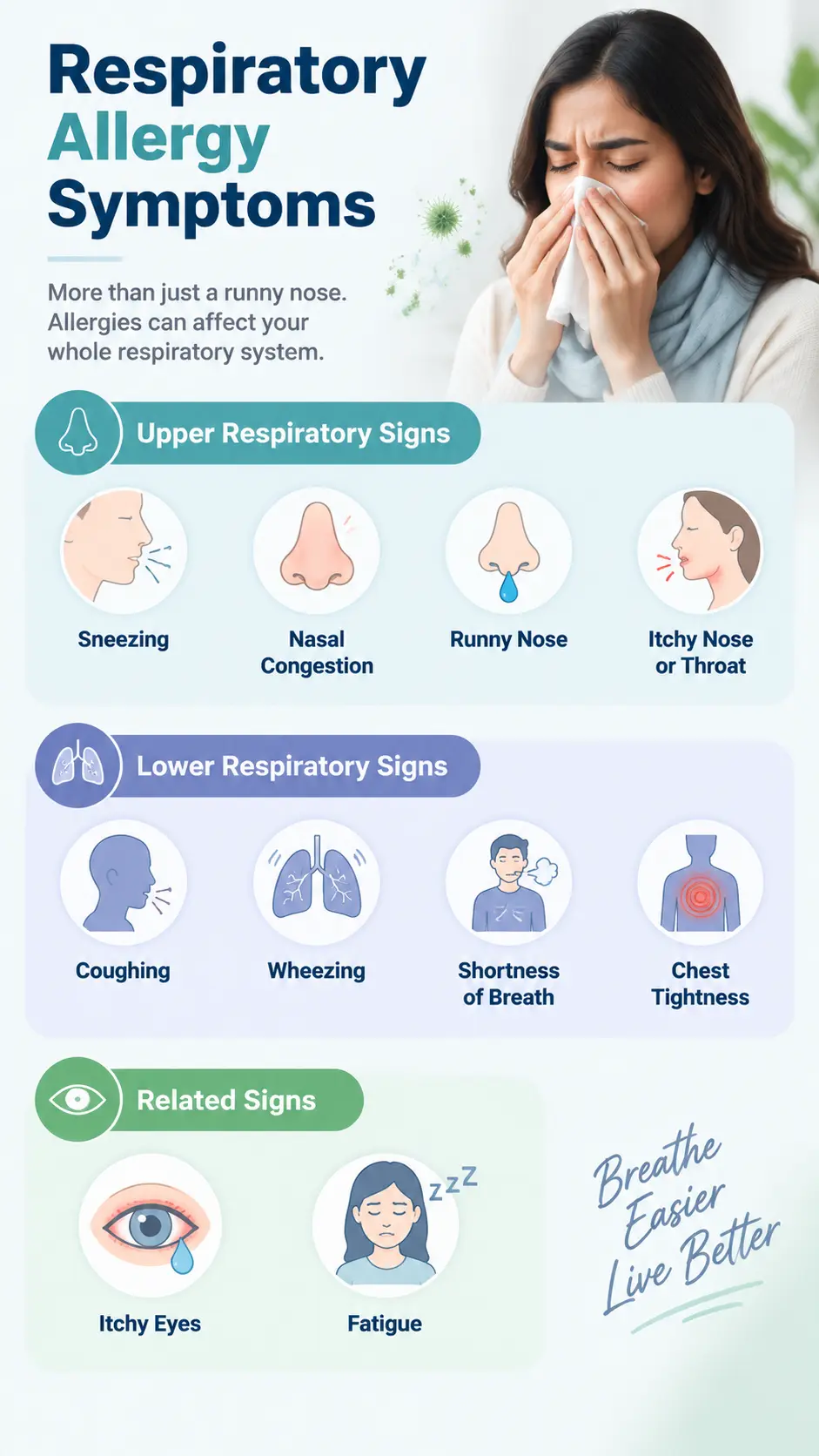

More Than Just a Sneeze: Understanding Chronic Respiratory Allergy Symptoms and Finding Lasting Relief

Namaste! I am Dr. Sameer Lote, and I work as a chest specialist at Panacea Clinic in Nagpur. Just last week, a very worried mother from the Dhantoli area sat in my clinic. She looked completely exhausted. Her young son had been dealing with a dry, hacking cough for over three weeks.
“Doctor,” she said, “we have tried everything. We gave him hot ginger-tulsi tea, we made him inhale steam twice a day, and we even tried local honey, but nothing is stopping this cough.”

As a pulmonologist who has treated respiratory conditions for over fifteen years, I hear this story almost every day. Many families in our city try one home remedy after another, hoping a stubborn cough or a runny nose is just a simple “cold” that will eventually pass. But when those symptoms refuse to go away, there is usually a different culprit at play: respiratory allergy symptoms.

respiratory allergy symptoms

Our airways face a lot of daily challenges. Sometimes we face dust from an ongoing construction, sudden seasonal temperature changes, and pollen floating through the air. 

For many people, these harmless particles trigger a massive immune reaction. If you or your child are struggling with constant sneezing, a blocked nose, or a cough that will not quiet down, you are not alone. 

Let us walk through what’s happening inside your body and explore how modern respiratory allergy treatment can help you breathe freely again.

The "One Airway" Connection: Why the Nose and Lungs are Partners

When patients come to my clinic, they often think of their nose and their lungs as two completely separate parts of the body. They believe that a nasal problem belongs to an ENT specialist, while a lung problem belongs to a chest doctor. 

But in modern medicine, we know this is not true. We use a concept called “One Airway Disease” or “United Airway Disease”.

Think of your respiratory system as a single, continuous pipeline. This pipeline starts at the tip of your nose and goes all the way down to the deepest air sacs in your lungs. 

The pipeline is lined with the exact same kind of wet, delicate skin, which we call the respiratory mucosa. It also shares the same immune defense cells. Because they are physically connected, an inflammatory fire starting in your nose can easily travel down and affect your lungs.

The medical statistics back this up in a big way:

  • Up to 80% to 88% of patients who have asthma also suffer from allergic rhinitis (nasal allergies).
  • About 10% to 40% of people with nasal allergies already have asthma or will develop it in their lifetime.
  • Having untreated nasal allergies makes your asthma symptoms much worse. It actually doubles the risk of emergency room visits and increases your chances of a severe asthma attack.

When you inhale a trigger like dust mites, your body does not just react in your nose. The inflammation spreads downward. This is why treating nasal symptoms is one of the most important steps in protecting your lungs.

Why Do Your Allergy Symptoms Feel Like a Two-Wave Attack?

Have you ever wondered why your allergies seem to have two different personalities? Sometimes you step into a dusty room and instantly start sneezing. 

Other times, you wake up the next morning feeling incredibly stuffed up, even though you are no longer near the dust. This happens because your body goes through two distinct waves during an allergic reaction.

Wave 1: The Early-Phase Response (The Fast Sneeze)

The Early Phase Response The Fast Sneeze

This wave happens within minutes of breathing in an allergen, like grass pollen or pet dander. Your body contains special allergy antibodies called Immunoglobulin E (IgE). These IgE antibodies sit on the surface of guard cells in your nose called mast cells.

When an allergen enters your nose, it keys into these antibodies like a puzzle piece. This instantly signals the mast cells to burst open and release a chemical called histamine

Histamine acts like an alarm bell. It irritates your local nerve endings, causing immediate, uncontrollable sneezing, watery eyes, and an itchy nose.

Wave 2: The Late-Phase Response (The Deep Congestion)

The Late Phase Response The Deep Congestion

This is where many patients get confused. They think because they are away from the trigger, the reaction should stop. But about 4 to 24 hours later, a second wave of inflammation begins.

Your immune system recruits helper inflammatory cells, specifically eosinophils, to migrate directly into your nasal lining. These cells cause the tissue inside your nose to swell up and produce thick, sticky mucus. This late-phase response is what causes that heavy, painful nasal block and deep chest tightness. Because it involves physical tissue swelling, it is much harder to treat with a simple quick-relief pill.

Respiratory Allergy vs. Cold vs. Flu: How to spot the difference

When a patient has a runny nose and a cough, their first thought is usually, “I have caught a cold” or “It must be the seasonal flu”. But treating an allergy like a viral infection will not bring you any relief. It is highly important to know how to spot the differences.

Respiratory Allergy vs Cold vs Flu

Visual Clues to Watch For in Children

Children cannot always explain what they are feeling, but their bodies leave very clear physical clues of chronic respiratory allergy symptoms:

  • Allergic Shiners: These look like dark, bluish-purple circles under the eyes. Parents often assume their child is just tired, but these dark circles are actually caused by swollen nasal passages blocking the natural blood flow around the eyes.
  • Dennie-Morgan Lines: These are extra, symmetrical skin folds or wrinkles right under the child’s lower eyelids, caused by constant eye swelling and rubbing.
  • The Allergic Salute: Watch how your child wipes their nose. Children with allergies often use the palm of their hand to rub their nose in an upward motion to relieve itching.
  • Transverse Nasal Crease: Over time, performing the “allergic salute” day after day creates a permanent horizontal line or crease across the bridge of the nose.

Diagnosis: Finding Your Personal Allergy Profile

To treat an allergy properly, we first need to identify your specific triggers. We do this using reliable, scientific testing, rather than guessing.

1. Skin Prick Testing (SPT)

This is the most common and reliable first-line test we use. It is safe, virtually painless, and performed right in the clinic. We place tiny drops of different allergen extracts (like dust mites, molds, or local pollens) on your forearm or back. Then, we gently scratch the surface of your skin through the drop using a tiny lancet.

You wait in the clinic for about 15 to 20 minutes. If you are allergic to a substance, a small, itchy bump (called a wheal) will appear, looking like a tiny mosquito bite.

2. Specific IgE Blood Testing

If you have a severe skin condition like eczema, or if you cannot stop taking your daily antihistamine medications, we perform a blood test instead. This test measures the exact amount of allergen-specific IgE antibodies in your blood. While the laboratory takes a few days to return the results, it is highly accurate and completely safe.

The Mystery of "Negative" Results: Local Allergic Rhinitis (LAR)

Sometimes, a patient has severe, classic allergy symptoms, but both their skin prick test and their blood test come back completely negative. This can be incredibly frustrating.

In these cases, the patient may have Local Allergic Rhinitis (LAR). This means their immune system produces allergy antibodies only locally in their nasal tissue, not in their blood or skin. The gold standard for diagnosing LAR is a Nasal Allergen Provocation Test (NAPT), where we spray a tiny, controlled amount of the suspected trigger directly into the nose to monitor the local reaction.

Step-by-Step Respiratory Allergy Treatment Plan

Overcoming allergies requires a systematic, clinical approach. We break respiratory allergy treatment down into three highly effective steps:

Step 1: Environmental Management (Fixing Your Space)

Environmental Management

You cannot medicate away an allergy if you are constantly breathing in the trigger. Focus on these highly effective adjustments:

  • Wash bedding weekly: Dust mites love your pillows and mattresses. Wash all your bed sheets and pillowcases in hot water (at least 130°F or 54°C) every single week to kill them.
  • Control humidity: Dust mites and molds thrive in damp air. Try to keep your indoor humidity levels between 30% and 50%.
  • Saline Nasal Irrigation: Using a simple saline squeeze bottle or a neti pot with distilled water is a fantastic, drug-free way to rinse out trapped pollens, dust, and thick mucus from your nose, keeping your nasal passages healthy.

Step 2: Step-Up Medications (Based on 2024-2025 Global Guidelines)

When lifestyle changes are not enough, we use targeted medical therapies based on the latest global clinical guidelines:

Step Up Medications

When Both Conditions Occur Together

  • Intranasal Corticosteroid (INCS) Sprays: If you have moderate-to-severe symptoms, steroid nasal sprays are the single most effective daily treatment. Unlike oral steroids, these sprays act locally inside your nose, meaning they are incredibly safe for long-term use and have minimal side effects.
  • Dual-Action Combination Sprays: The newest 2024–2025 ARIA-EAACI guidelines strongly suggest using a combination spray that contains both a steroid (INCS) and an antihistamine (INAH) in one bottle. This gives you the rapid, direct relief of an antihistamine along with the deep, swelling-reducing power of a steroid.
  • Oral Antihistamines: For mild or occasional symptoms, second-generation oral antihistamines (like fexofenadine, levocetirizine, or loratadine) are excellent. They stop sneezing and itching quickly without causing the heavy drowsiness of older, first-generation medicines.
  • Montelukast: This tablet is highly effective if you have both nasal allergies and asthma. However, because of rare but serious neuropsychiatric warnings (like mood changes or vivid dreams), we only prescribe it when other standard treatments are not a good fit.

Step 3: Allergen Immunotherapy (The Only Root-Cause Cure)

All other medicines are like umbrellas—they protect you from the rain, but they do not stop the storm. Allergen Immunotherapy (AIT) is the only treatment that actually changes how your immune system behaves.

AIT involves giving your body tiny, gradually increasing doses of the very substance you are allergic to. Over a period of 3 to 5 years, your immune system learns to stop treating the pollen or dust mite as an enemy, building permanent, long-term tolerance. We can deliver this treatment through:

Allergen Immunotherapy
  1. Subcutaneous Immunotherapy (SCIT): Regular, tiny injections given at our clinic.
  2. Sublingual Immunotherapy (SLIT): Daily, rapidly dissolving tablets or drops placed under your tongue at home.

AIT is highly successful, even for patients suffering from Local Allergic Rhinitis (LAR).

Breathe Easy: Let Us Find Your Solution

You do not have to live your life with a constantly blocked nose, a heavy chest, or a cough that keeps you awake at night. Allergies are highly treatable, and taking control of your respiratory health today can prevent more serious respiratory issues from developing in the future.

If you are tired of temporary quick fixes and want a personalised, science-based diagnostic plan, visit us at Panacea Clinic (Dhantoli, Nagpur). Let us work together to find your triggers, clear your airway, and help you and your family breathe with ease.

Next Step for Your Health: 🩺 To help me understand your symptoms better, check out our interactive Allergy & Cough Treatment Self-Assessment Tool on our website, or book an appointment at Panacea Clinic for a personalised diagnostic plan. Let us clear your airway together!

Latest Blogs