Breast Cancer at 30: Why Young Indian Women Are at Risk
Namaste,
Last Tuesday, I met Priya in my clinic. She’s 32, works in IT, newly married, and was holding a report that had just turned her world upside down.
“Doctor, breast cancer? Mere umar mein? I thought this only happened to older women.”
As a breast oncologist in Nagpur, I hear this more often than you’d think.
The truth is, breast cancer doesn’t wait for you to turn 50. In India, we’re seeing more and more young women in their 20s and 30s walking through our doors with a diagnosis they never saw coming.
And today, I want to talk to you about why this is happening.
The Numbers Don't Lie
Let me show you something that might surprise you.
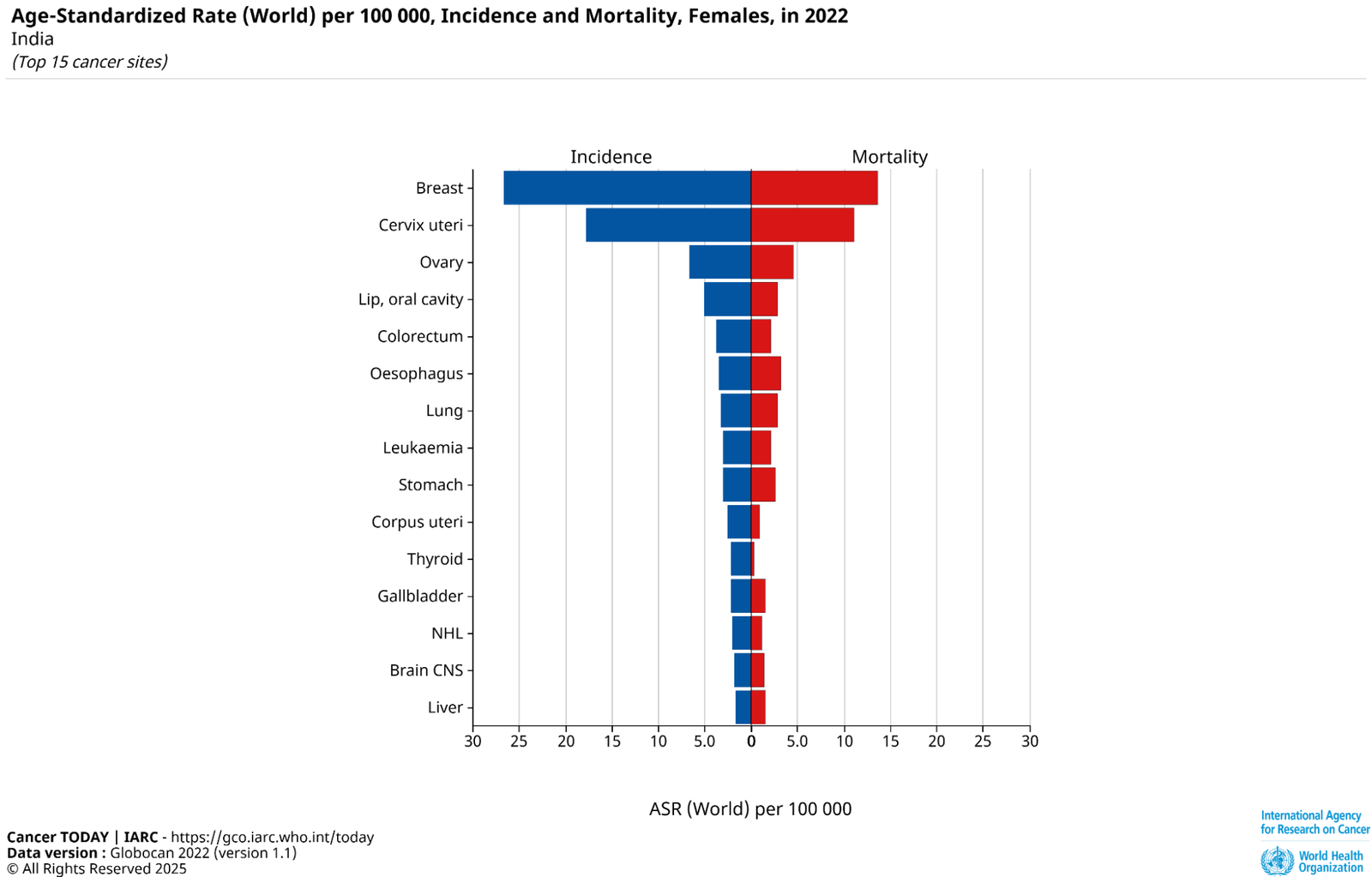
See that? Breast cancer is now the number one cancer among Indian women, not just in incidence, but also in mortality.

India accounts for nearly 98,337 breast cancer deaths annually, which is 31.2% of all breast cancer deaths in Asia. We’re not just talking about numbers; we’re talking about people. These are daughters, mothers, sisters, friends.

In the global picture, India ranks third in both incidence (192,020 new cases) and mortality (98,337 deaths). We have a real problem on our hands.
The estimated number of incident cancer cases in India for the year 2022 was 14,61,427 (crude rate: 100.4 per 100,000). In India, one in nine people are likely to develop cancer in his/her lifetime. Lung and breast cancers were the leading sites of cancer in males and females, respectively. |
The estimated number of incident cancer cases in India for the year 2022 was 14,61,427 (crude rate: 100.4 per 100,000). In India, one in nine people are likely to develop cancer in his/her lifetime. Lung and breast cancers were the leading sites of cancer in males and females, respectively.
But here’s what I want you to know: many of these cases can be detected in early stages thereby increasing survival outcomes.
Why Is Breast Cancer Happening to Young Indian Women?
Over my years as a breast oncologist in Nagpur, I’ve noticed specific patterns. There are things we’re doing or not doing that are quietly increasing our risk. Let me walk you through them, one by one.
1. That Cigarette Smoke You're Breathing
“But Doctor, I don’t smoke,” Priya told me.
“What about your husband? Your father? Ghar mein koi smoke karta hai?”
She paused. “Haan… my father-in-law smokes in the living room.”
Here’s what happens: tobacco smoke contains more than 20 chemicals that can damage your breast tissue. Even if you’re just breathing it in, these chemicals attach themselves to your DNA. We call them DNA adducts, and they don’t let go. They sit there, slowly causing mutations, especially in a gene called p53 that normally protects you from cancer. (Source)
What you can do: Create a smoke-free home. It’s not just about your lungs, it’s about your breasts too. Have that difficult conversation with your family. Thoda mushkil hoga, I know. But your health is worth it.
2. Birth Control Pills
I’m not here to scare you away from contraception. But I do want you to understand what’s happening inside your body.
Birth control pills contain synthetic versions of estrogen and progesterone, the same hormones that naturally make breast cells grow. When you take these pills, especially for many years, you’re giving your breast cells extra signals to multiply. And every time a cell divides, there’s a tiny chance of a mistake, a mutation that could eventually lead to cancer.
Research shows that women currently using or who recently stopped using oral contraceptives have about a 20-30% higher risk of breast cancer. (Source) |
What you can do: Talk to your gynaecologist. Ask about non-hormonal options. Pills zaruri hain kya? If you do use hormonal contraceptives, use the lowest dose for the shortest time needed. Meet your breast specialist and understand your risk of breast cancer before starting any hormone supplements. The good news? The risk goes down after you stop using them.
3. "It's Just a Benign Lump, Right?"
“Doctor, I had a fibroadenoma removed three years ago. They said it was benign, so I didn’t worry about it.”
I hear this a lot. And yes, benign means non-cancerous. But here’s what we’ve learned: some benign breast conditions create an environment in your breast tissue where cancer finds it easier to develop. If you have had a fibroadenoma, it just means your breast cells have a tendency to proliferate and grow at a higher rate.
Women with a tendency to develop fibroadenomas have 2.17 times the risk of developing breast cancer compared to women without them. If it’s a complex fibroadenoma, the risk increases to 3.10 times. (source) |
What you can do: Don’t ignore that lump just because someone said it’s benign. Check your breasts every month. Know what’s normal for you. If you’ve had a complex fibroadenoma, talk to a breast oncologist about whether you need more frequent screenings or further evaluation of the lump.
4. What's on Your Plate Matters
Last week, a patient asked me, “Doctor, can what I eat really cause breast cancer?”
The answer is more complicated than yes or no, but here’s what science tells us:
Red meat, especially when cooked at high temperatures such as grilling or frying, forms chemicals called heterocyclic amines. These are carcinogens. Red meat also contains heme iron, which triggers reactions in your body that can eventually lead to tumours.
Processed meats? Even worse. They’re linked to a 9% higher risk, while unprocessed red meat carries a 6% higher risk. (source) |
And here’s something that bothers me: the hormones given to cattle to make them grow faster? Those hormones can end up in the meat you eat, and they can fuel hormone-sensitive breast cancers.
What you can do: I’m not asking you to become a vegetarian overnight. But can you eat more dal, rajma, chole? More sabzi? More whole grains? Can you limit meat to once or twice a week? Small changes, big difference.
5. Obesity and comorbidities
Obesity is a real risk factor, especially for breast cancer in India and across the world.
Here’s why: fat tissue, particularly after menopause, becomes your body’s main factory for producing estrogen. The more fat tissue you have, the more estrogen you produce. And estrogen, as we’ve discussed, can fuel breast cancer growth.
But there’s more.
Fat tissue in obese individuals doesn’t just produce estrogen; it creates inflammation, releases harmful chemicals, and basically creates a neighbourhood where cancer cells feel welcome. (source) |
What you can do: Even a 5% weight loss can make a difference. That’s just 3-4 kg for someone weighing 60 kg. Walk for 30 minutes daily. Take the stairs. Dance to your favourite songs. Bas thoda sa movement. Small changes add up.
6. The Choice Not to Breastfeed
In our generation, I’m seeing more women choose not to breastfeed or breastfeed for very short periods. Career pressures, convenience, and personal choice, I understand all of it.
But let me tell you what breastfeeding does: it gives your breast cells a chance to mature and differentiate. It reduces the number of menstrual cycles you have (and thus your lifetime exposure to estrogen). It’s like giving your breasts a protective shield.
Women who breastfeed for at least 12 months or more have a lower risk of developing breast cancer and ovarian cancer. The longer you breastfeed, the more protection you and your baby receive. (source) |
What you can do: If you’re planning to have children, try to breastfeed as much as possible. I know it’s not easy. I know there are challenges. But from a breast health perspective, it’s one of the most protective things you can do.
7. Family history and genetics
This is the myth I hear most often, and it’s time we talk about it.
“Doctor, hamare ghar mein toh kabhi kisi ko nahi hua.”
Listen carefully: More than 85% of women I diagnose with breast cancer have NO family history.
But if you do have a family history, especially if your mother, sister, or grandmother had breast or ovarian cancer, then we need to talk about genes like BRCA1 and BRCA2.
These are your body’s tumour suppressor genes. They’re supposed to repair DNA damage. However, when they’re mutated, they are unable to perform their job.
Women with BRCA1 mutations have a 55-65% chance of developing breast cancer by age 70. With BRCA2, the rate is approximately 45%. (source) |
What you can do: Be open with your doctor about your family history. If there’s a strong pattern of breast or ovarian cancer in your family or a history of multiple cancers in the family, genetic testing might be appropriate. And if you do carry these mutations, we have strategies—from enhanced screening to preventive medications to even prophylactic surgery in high-risk cases.
8. Passive Lifestyle and Menstrual Factors
Did you get your first period before age 12? Are you someone who went through menopause after age 55?
Both of these mean your body was exposed to estrogen for longer than average. As we’ve discussed, estrogen exposure is important.
| Each year, being younger at the first period (menarche) increases your breast cancer risk by 5%. Each year older at menopause increases it by about 3-4%. (source) |
What you can do: You can’t change when your period starts or ends. But you CAN control other factors. Maintain a healthy weight. Exercise regularly. These lifestyle choices help balance your hormones and offset some of that risk.
If you suffer from post menopausal symptoms like hot flashes, do not rush to grab hormone replacement therapy. Talk to your gynaecologists about the risks versus the benefits. Consult your breast specialist whether it will affect your risk of breast cancer, because, as we discussed, additional hormones without supervision can be harmful.
9. Exposure to Environmental Toxins (Tobacco Chewing, Partner's Addictions, Alcohol)
“Bas one glass of wine with dinner, Doctor. That can’t be harmful, right?”
I wish I could say yes. But here’s what alcohol does: your body breaks it down into acetaldehyde, a toxic chemical that damages your DNA. And breast tissue? It’s not very good at breaking down acetaldehyde. So it accumulates. It builds up. It becomes increasingly toxic over time.
Even moderate drinking, what most people would call “social drinking,” raises breast cancer risk.

Add to this secondhand exposure from a partner who smokes or chews tobacco, and you’re creating a perfect storm in your own home.
What you can do: If you drink, keep it to a minimum, and I mean truly occasional. Better yet, skip it altogether. And create a tobacco-free zone in your home. Your partner’s habits affect your health too.
What Can You Do Starting Today?
I know this is a lot of information to take in. And I know it might feel overwhelming. But here’s what I want you to remember:
Knowledge is power. Awareness saves lives.
As a breast surgeon and specialist in Nagpur, I’ve seen women catch their cancer early because they were informed and vigilant. And I’ve seen women who could have been saved if only they’d known sooner.
So here’s my simple action plan for you:
- Check your breasts monthly—4-5 days after your period ends
- Move your body—at least 150 minutes of exercise per week
- Eat more plants—less red meat, more vegetables, whole grains, and legumes
- Create a smoke-free,alcohol-free home
- Breastfeed if and when you can
- Know your family history and share it with your doctor
- Get screened—mammograms from age 40, or earlier if you’re high-risk
A Personal Note
You are not just a statistic to me. You are not just a case number.
When you walk into my clinic at Panacea, you’re walking into a space where you’ll be heard, where your concerns matter, and where we’ll take the time to explain things in a way that makes sense to you.
Breast cancer treatment in Nagpur isn’t just about surgery and chemotherapy. It’s about understanding your unique risk factors, creating a personalised prevention and screening plan, and supporting you every step of the way, whether you’re here for prevention, diagnosis, or treatment.
If you’re reading this and feeling worried, or if you’ve noticed changes in your breasts, or if you just want to have a conversation about your risk factors, please reach out.
Because the best time to catch breast cancer is before it even starts.
And the second-best time is right now.
Take care of yourself. You’re worth it.
Dr. Arundhati Marathe Lote
Breast Oncologist
Panacea Clinic, Nagpur
Have questions or concerns about breast cancer risk? Book a consultation at Panacea Clinic. We’re here to help.
Latest Blogs