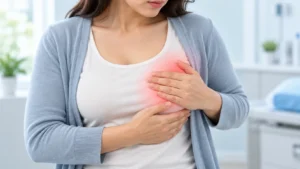
Diet, Lifestyle, and Prevention: Breast Health Tips for Indian Women
Learn how diet, lifestyle changes, and early habits support the prevention of breast cancer in Indian women. Practical breast health tips from Panacea Clinic.
Namaste, My Dear Sisters
I see women every day – mothers, teachers, students, homemakers. And I see one pattern.
Women put everyone first.
And themselves last.
Your health is not a luxury.
It is a responsibility.
For yourself.
For your family.
For your future.
Let me tell you something that will surprise you. Every 4 minutes, one Indian woman is diagnosed with breast cancer.
Yes, you read that right. Four minutes.
I’m Dr. Arundhati, and as a breast specialist doctor in Nagpur, I see this reality every single day. But here’s what gives me hope – you have more power than you think to protect yourself.
Most breast cancers can be detected in early stages, thereby increasing survival outcomes.
Many risk factors are modifiable, and early detection is proven to save lives.
That’s why diet, lifestyle, and routine checks matter.
Breast cancer has become the number one cancer among Indian women. It overtook cervical cancer. In 2024 alone, India saw over 238,000 new breast cancer cases.
But here’s the scariest part – 60% of Indian women are diagnosed at Stage III or Stage IV. That’s the late stage, when treatment becomes much harder.
Why?
Because we don’t talk about it, we don’t check ourselves. We don’t know what to look for.
And that needs to change. Right now.
Listen carefully, because this is important.
We get breast cancer at a younger age than women in Western countries. Over 50% of cases happen in women aged 25-50 years.
Our bodies are also different. 1 in 28 Indian women will develop breast cancer in their lifetime, and the risk is higher in cities compared to villages.
So the advice you find online, primarily written for American or European women, doesn’t always work for us.
Let’s fix that.
Listen carefully, because this is important.
We get breast cancer at a younger age than women in Western countries. Over 50% of cases happen in women aged 25-50 years.
Our bodies are also different. 1 in 28 Indian women will develop breast cancer in their lifetime, and the risk is higher in cities compared to villages.
So the advice you find online, primarily written for American or European women, doesn’t always work for us.
Let’s fix that.
Forget what you know about weight loss for a minute.
For Indian women, where you carry your weight matters MORE than how much you weigh.
Let me explain with science: A study from Mumbai’s Tata Memorial Hospital found something shocking. Women with a waist-to-hip ratio of 0.95 or higher had 4 times the risk of breast cancer before menopause and 3 times the risk after menopause, even if their weight was normal!
This is called central obesity. It’s when fat accumulates around your belly rather than your hips or thighs.
Get a measuring tape. Let’s do this together:
Step 1: Measure your waist
Step 2: Measure your hips
Step 3: Calculate
Your Target: Keep it below 0.85
If your WHR is above 0.85, don’t panic. You can fix this! Central obesity increases breast cancer risk by three times for Indian women, but we can work on it to reduce this ratio.
When fat sits around your belly, it doesn’t just sit there quietly. It’s active!
Belly fat produces extra estrogen (a hormone). Too much estrogen increases breast cancer risk. It also causes inflammation throughout your body and messes with your insulin levels, all bad news for breast health.
Important: You don’t need to give up Indian food! Just make small changes in how you cook.
I remember my dadi used to say haldi cures everything. Well, she wasn’t entirely wrong!
Turmeric contains curcumin, a powerful compound. Laboratory studies show curcumin can stop the growth of breast cancer cells, though more research is needed to confirm this works the same way in our bodies.
People whose diets are rich in turmeric have a comparatively lower risk of breast cancer. (source)
Important Safety Note: Using turmeric in cooking is very safe. But taking high-dose turmeric supplements during cancer treatment can be risky, so always talk to your doctor first if you’re already diagnosed.
Pro Tip: Always add a pinch of black pepper to your turmeric. Research shows that compounds from black pepper enhance turmeric’s effects.
Sitting too much is dangerous.
Long hours of sitting with minimal physical activity increase obesity risk and, hence, breast cancer risk.
You don’t need an expensive gym membership. Here’s what works:
Daily (30 minutes minimum):
Why 30 Minutes? Experts recommend at least 30 minutes of regular physical activity daily to keep weight in check and reduce cancer risk.
Suppose you have children or are planning to have them, listen up. This is powerful.
4.3%. That’s on top of the 7% decrease from each pregnancy!
Women who breastfeed for at least 12 months or more have a lower risk of developing breast cancer and ovarian cancer. The longer you breastfeed, the more protection you and your baby receive. (source) |
Let that sink in. Breastfeeding for just one year cuts your risk by almost one-third.
The protection is cumulative. If you breastfeed for a year or more in total across all your children, you get significantly reduced breast cancer risk.
Even if you had breaks between children, it all adds up!
Example: If you breastfed Baby 1 for 8 months and Baby 2 for 10 months, that’s 18 months total. Good protection!
Here’s a shocking fact: Initial breast self-examination awareness was below 1% in many Indian communities.
Less than 1%!
That means 99% of women don’t check their own breasts. This has to change.
Women who regularly examine their breasts can detect 90% of all breast lumps. Early detection means easier treatment and better survival.
In Nagpur and across Maharashtra, many women come to me only when there’s a big lump or the skin changes. By then, treatment is harder.
Don’t wait. Check yourself monthly.
Best Time: Just at the end of your period, when breasts are least tender.
If you don’t get periods, pick the same date each month.
What You’re Looking For:
DON’T PANIC!
80% of breast lumps are not cancerous.
But do this:
Early detection saves lives. The 5-year survival rate for breast cancer caught early is much higher than for late-stage detection.
Case–control studies from different regions of India have found that women with higher intakes of animal protein, visible fats (like ghee, oils, animal fat) and deep‑fried or fatty foods tend to have higher odds of breast cancer compared with women consuming less of these items. (source)
Our traditional Indian diet can be either protective or risky, depending on how we eat.
Not Banned, Just Reduce:
Age: Risk increases as you approach 50-64 years, but young Indian women are also affected.
Family History: If your mother or sister had breast cancer before age 40, or you have a significant family history then your risk is higher. Tell your doctor and get screened earlier.
Now, let’s talk about what might be causing these problems in your home environment. This is where understanding your specific situation becomes really important.
you have:
Red Flags to Watch:
What to Do: If this sounds like your family, tell your doctor immediately. You may need screening starting at age 30-35 instead of 40.
Here’s something powerful – only 5-10% of breast cancers are strongly hereditary.
The rest involve something called epigenetics.
Think of your genes like light switches. They’re there, but epigenetics decides whether they’re “on” or “off.”
Your daily choices, like what you eat, how you move,and your stress levels, send signals to your genes. Lifestyle changes through diet can impact how cancer-related genes behave.
In Simple Terms:
Even if you have risky genes, a healthy lifestyle can keep them in “sleep mode.”
Your genes load the gun, but your lifestyle decides whether it fires.
This is why all those diet and exercise tips matter so much. They’re literally talking to your genes every single day!
Important for my Nagpur and Maharashtra sisters!
Betel quid (with lime and tobacco) chewing is a significant independent risk factor for breast cancer in certain Indian regions. (source)
If you chew paan regularly, please try to quit. Talk to your doctor about nicotine replacement if needed.
Every woman over 40 should get screened.
But in India, because we get cancer younger, I recommend:
Age 30-40:
Age 40-50:
Age 50+:
High Risk (Family History):
Don’t wait for your next check-up if you notice:
Remember: Only 0.9% of Indian women aged 30-49 undergo breast cancer screening. Don’t be part of that statistic.
I see it in my clinic every day. Women whisper about breast health. Daughters-in-law don’t tell mothers-in-law. Wives hide lumps from husbands.
This silence kills.
General ignorance of women about breast cancer, its symptoms, and the value of regular screenings is a significant obstacle to early identification.
I’ve been a breast cancer specialist in Nagpur for many years. I’ve seen too many young women, too many mothers, too many daughters fighting breast cancer.
But I’ve also seen survivors. Strong women who caught it early. Women who made lifestyle changes and protected themselves.
You have power. Real power to reduce your risk.
You don’t need expensive treatments or fancy supplements. You need:
Start today. Not tomorrow. Today.
Check your breasts this week. Calculate your waist-hip ratio. Add haldi to your dal. Go for a walk. Tell another woman about this.
Small steps, significant impact.
And remember, I’m here in Nagpur if you need me. Don’t be afraid to ask questions. Don’t delay check-ups. Don’t ignore warning signs.
Your life is precious. Your health matters. Your family needs you to be healthy.
Let’s fight breast cancer together, not by being afraid, but by being informed and proactive.
Stay healthy, stay aware, stay strong.

Learn how diet, lifestyle changes, and early habits support the prevention of breast cancer in Indian women. Practical breast health tips from Panacea Clinic.

Namaste, Last Tuesday, I met Priya in my clinic. She’s 32, works in IT, newly married, and was holding a report that had just turned

Yesterday I was passing near a college and I saw a group of students vaping near the campus. Probably one of them was reluctant to

As women, we notice changes in our breasts and get worried about them. With so much information available online, we try to diagnose ourselves and

Namaste,I’m Dr. Arundhati Marathe Lote, a breast cancer surgeon. But before anything else, I’m a woman, just like you. And today, I want to talk

As a chest specialist practising in Nagpur for over twelve years, I have had the privilege of helping hundreds of families understand pulmonary fibrosis treatment.